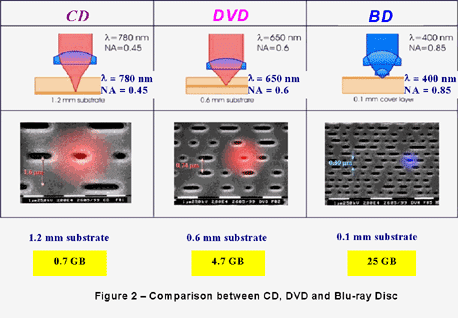
ARTICLE APRIL 2003 BLU-RAY DISC OFFERS RADICAL ADVANCE IN HIGH CAPACITY STORAGE Blu-ray Disc (BD) is a radically new optical storage medium, jointly developed by nine of the world?s leading consumer electronics and optical storage companies*. It should not be considered a replacement for DVD formats, which are expected to meet the requirements of standard definition TV (SDTV) recording and film distribution for many years to come, but as a basis for future even higher quality recording products. In terms of storage capacity, Blu-ray Disc is as different to the DVD as the DVD was to the compact disc (CD). High-definition video recording may be the starting point for Blu-ray Disc, but it is certainly not the only application that will ultimately leverage its very high storage capacities ? over 25 GB compared with the 4.7 GB of DVDs ? and high-speed data transfer rates in the order of 36 MB/s. Blue laser precision In order to play back full-length feature films, DVDs store digitally encoded video and audio information in the form of ?pits? and ?bumps? that are pressed into a recording track that spirals out from the centre of the disc to its edge. The different reflectivity of these pits and bumps enables the laser pick-up to read information from the disc. To provide similar length playback of high-definition TV (HDTV) pictures, at least four times the storage capacity of a standard DVD is required. To achieve the bit density necessary to put this amount of data on a low-cost single-sided 12-cm optical disc, the size of the pits pressed into it must be smaller. It must also be possible to focus the illuminating laser well enough to create a correspondingly small ?laser-spot? that can reliably read the smaller pits on the disc. A fundamental law of physics states the diameter of the laser spot is directly proportional to the wavelength of the laser light and inversely proportional to the numerical aperture of the objective lens ? a figure that depends on the diameter of the lens, its radius of curvature and the material from which it is made. To reduce the size of the laser spot requires use of a shorter wavelength laser or a higher numerical aperture lens. Better still is a combination of both, which is the approach adopted in the Blu-ray Disc specification. Blu-ray Disc drives use a 405-nm wavelength blue laser and a lens with a numerical aperture of 0.85, instead of the 650-nm red laser and 0.60 numerical aperture lens used in current DVD drives ? see Figure 1. This allows a Blu-ray Disc drive to read reliably pits on the disc that are a mere 0.15-?m long ? more than 2.5 times shorter than the shortest pits on a DVD. Together with the longer recording track achieved by reducing the track pitch from 0.74 ?m to 0.32 ?m, this allows a single-layer Blu-ray Disc to store up to 25 GB of data ? enough to provide two to thee hours of HDTV recording and playback.
Blu-ray Disc is not just a technological solution. It has been designed with commercial considerations in mind. The blue laser diodes it uses are now available, while the optical assemblies and servo mechanisms needed are compatible with current high-volume manufacturing techniques. In addition, Blue-ray discs can be mechanically pressed on the same equipment used to produce prerecorded CDs and DVDs. Unlike CDs and DVDs, where compatibility issues have arisen because of the need to add recordable and rewritable format extensions to an initial read-only concept, Blu-ray takes the rewritable format as the starting point for the entire specification. Using phase-change recording technology similar to that developed for DVD+RW, Blu-ray also features random access for both reading and writing, enabling high compatibility across PC and consumer product domains and across data and audio/video applications. The Blu-ray recording layer One of the features that differentiates Blu-ray Disc from DVD recording systems is the position of the recording layer within the disc. For DVDs, the recording layer is sandwiched between two 0.6-mm thick layers of plastic ? typically polycarbonate. The objective is to shift surface scratches, fingerprints and dust particles to a position in the optical pathway where they will have negligible effect ? that is, well away from the point of focus of the laser. However, burying the recording layer 0.6 mm below the surface of the disc also has disadvantages. The injection moulding process used to produce CDs leads to stress-induced birefringence in the substrates. Birefringence can lead to the splitting of the single incident laser light into two separate beams ? if this splitting is excessive, the drive cannot read data reliably from the disc. Consequently, the injection moulding process has always been a critical part of CD and DVD production. Another crucial manufacturing parameter, particularly for DVDs, is the flatness of the disc, because the laser beam becomes distorted if the disc surface is not perpendicular to the beam axis ? a condition referred to as disc tilt. This distortion increases as the thickness of the cover layer grows and for higher numerical aperture lenses. To overcome these disadvantages, the recording layer in a Blu-ray Disc sits on the surface of a 1.1-mm thick plastic substrate, protected by a 0.1-mm cover layer. With the substrate material no longer in the optical pathway, birefringence problems are eliminated. In addition, the closer proximity of the recording layer to the drive?s objective lens reduces disc tilt sensitivity. This only leaves the problem of surface scratching and fingerprints, which can be prevented by applying a hard coat on top of the cover layer. This protective coat is hard enough to prevent accidental abrasions and also allows fingerprints to be removed by wiping the disc with a tissue. Both the cover layer and hard coat can be applied by low-cost manufacturing techniques such as spin-coating. Disc manufacturing Despite the fact that Blu-ray Discs require the application of a cover layer and an optional hard coat, this should have little overall impact on manufacturing costs. DVD production currently requires the injection moulding of two 0.6-mm discs (one of which must meet stringent birefringence limits), the application of a recording layer to one of the discs, and a gluing operation to bond the two discs together. Blu-ray Discs require only the injection moulding of a single 1.1-mm substrate with non-critical optical characteristics ? reducing moulding costs. This saving offsets the additional cost of applying the cover layer and hard coat, while the techniques used for applying the recording layer remain the same. As a result, the overall cost of manufacturing a Blu-ray Disc should be no more than that of producing a DVD, while some equipment such as injection moulding machines can actually be used more efficiently. Because of the thinness of the cover layer, surface-flatness tolerances become far less stringent, while relative cover-thickness tolerances remain almost the same as for current DVD production. Drive compatibility Although no blue-laser disc will be readable using a red laser, combined blue-/red-laser drives are perfectly feasible. Servo-mechanisms that are capable of meeting Blu-ray Disc?s track positioning will be more than capable of meeting DVD requirements, while it should also be possible for both the blue and red lasers to share part of the optical pathway. There is no doubt that existing red-laser technology will be extended to increase further the versatility of the DVD format. Several developments in this area are already under way. However, while they may extend playback times for SDTV, provide short film HDTV playback or resolve incompatibility problems, none of these developments is likely to achieve the capability for high-definition playback of full-length blockbuster films. With Blu-ray Disc, 25 GB is the starting point for a format that already has the requirements built in for a next-generation optical recording format - two- to three-hour HDTV playback, real-time HDTV recording, rewritable, recordable and read-only versions, random access, cross-platform compatibility, and x2 single-sided capacity extension.
*Hitachi Ltd, LG Electronics Inc., Matsushita Electric Industrial Co. Ltd, Pioneer Corporation, Royal Philips Electronics, Samsung Electronics Co. Ltd, Sharp Corporation, Sony Corporation and Thomson Multimedia | |||