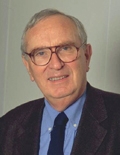
ARTICLE MARCH 2001 MEDEA+: the legacy and the future The outgoing chairman of MEDEA, Jürgen Knorr, and the incoming Chairman of MEDEA+, Jean-Pierre Noblanc, discuss the new, industry initiated and government supported 2 x 4 years programme, started 01.01.01.
Opening the discussion on Europe's microelectronics programmes past, present and future, leads automatically to the question of the difference between the objectives of the three programmes that have been initiated since 1989 : JESSI, MEDEA, MEDEA+. Looking back into the mists of the mid-1980's, Europe had fallen well behind its global competitors in semi-conductor research, development and manufacturing. Analysing that situation and realising that microelectronics would be the key enabling technology for the information age, the European industry and national governments started to change their conservative industrial attitude and also with the support of the European Commission, they installed JESSI, a Joint European Sub-micron Silicon programme, in 1989, in order "to close the gap in the technology of semiconductors," said Mr. Knorr. JESSI came to an end in 1996, with the celebratory JESSI day, at which the industry, politicians and media came together to look back over 7 years of progress. In that time, Europe took again its place among the front-runners in microelectronics technology, but the challenge was not over. "After the impressive European technological recovery in Microelectronics, conducted by the JESSI programme, the aim of the following MEDEA programme was to apply these technological advances in terms of innovative circuits covering the application domains strategic for Europe: telecommunications, consumer- and automotive electronics," commented Mr. Noblanc. The MEDEA programme : Microelectronics Development for European Applications ran from 1996 to 2000 and in that time took Europe's three leading microelectronics companies, Siemens-Semiconductors (today Infineon), Philips and STMicroelectronics into the world Top 10. "What we achieved was to manufacture dedicated application ICs in competitive volumes, out of Europe," said Mr. Knorr. As the next major European step in the ongoing global race for leading-edge microelectronics and ICT supremacy, the now following new MEDEA+ programme faces a different set of challenges. Mr. Knorr characterises the change as being from a technology development and globally competitive manufacturing to a focus on innovation of systems realised on silicon. "The challenge for MEDEA+ is to create new, highly advanced electronic systems for the markets of ICT industries through system innovation on silicon with high-complex ICs in state of the art technologies." Mr. Knorr also stresses the importance of the ITRS, the globally accepted roadmap which sets the direction of the industry through 2014 - the next 15 years. Mr. Noblanc looks at his challenge from an application's perspective. "MEDEA+ has to strengthen its application orientation, developing innovative systems on silicon for 3G mobile telecommunications, next generation Internet, digital consumer electronics, automotive electronics, highly secured smart cards and the like," he said. What does Mr. Noblanc see as his major challenges for the next 8 years. "I believe that MEDEA+ will oversee some major changes in the industry," he said. "Key challenges will be to keep a position at the leading edge of technology, make advances in sub 100 nanometer processes on 300 mm wafers, new systems-on-silicon architectures for multi-platform operation and low power technologies and embedded software." Mr. Knorr concurred, adding the resulting needs "to protect and learn how to deal with Intellectual Property." The long-term goal of the programme is to change Europe from participant into leader in microelectronics, and if past performance is an indication for the future, the future looks bright. But what of the short term? "My priorities for the next few months are clear," said Mr. Noblanc. "To quickly launch the already labelled MEDEA+ projects in collaboration with the public authorities and develop contacts with European Commission's IST (Information Society Technologies) programme to underline the importance of research in microelectronics for the future 6th Framework Programme for European research." | |||||||||||||