ARTICLE - MAY / JUNE 2004 1. Executive Summary on Heterogeneity on silicon or in a package for future system innovation 1. Executive Summary on Heterogeneity on silicon or in a package for future system innovation In the coming decade silicon devices will be divided into two main categories :
For this type of system, heterogeneity on silicon or in a package is the main feature for system integration. Due to the growing importance of heterogeneous systems for the European semiconductor industry, a subcommittee of the MEDEA+ Scientific Committee was formed, with experts from CEA-LETI, Fraunhofer Gesellschaft (FhG) and IMEC. A contribution from industrial experts was added at a later stage. For the sake of simplicity, the report focuses on silicon technologies, excluding optical devices and systems, as well as flexible electronics (e.g. on plastics). In the same way, harsh environments requiring dedicated technologies are not specifically discussed. It should also be stressed that embedded software is not detailed in the document, though it contributes to a large extent to the final cost of the system. 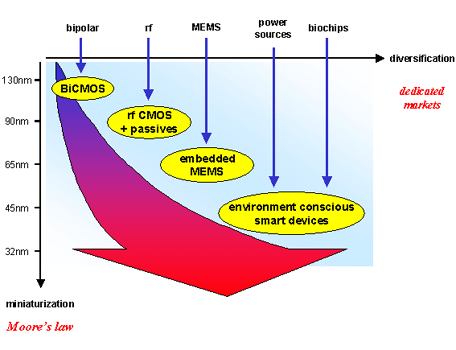 Many important applications for heterogeneous systems fit in the 'Ambient Intelligence' theme, where integrated systems are defined as smart devices which are conscious of and self-adapting to their environment while communicating with a dynamically reconfigurable network of other devices. Technological challenges include extremely low-leakage CMOS, high quality RF devices (passives, MEMS, etc.) and new packaging solutions. The major design challenge deals with the co-design of programmable and reconfigurable multiprocessor architectures with distributed memories and including embedded software, broadband radios, etc. For the longer term, completely three-dimensional packaging solutions of chips coming from extremely heterogeneous technologies must be developed as sketched by the "e-grain" or "smart dust" concepts. Here, novel power sources based on thin film batteries, fuel cells, inductive coupling or various MEMS concepts must be considered, as well as sophisticated physical and (bio)chemical interfaces to and from the outside world. The ability to exchange a broad range of complex design parameters between devices from different technologies, packages, and systems in a concurrent co-design targeted towards lower cost will be an extraordinary challenge, needing to close additional technical and cultural gaps through a multidisciplinary approach. The major technology directions are covered in the document along two broad routes, namely the system design side, with a specific discussion on test, and the system packaging technology, with key focus on the wafer level packaging, the vertical integration and the System-in-a-Package concept, adding a separate discussion on the integrated energy supply. The report is intended to be neither a roadmap nor a market study, but rather aims at describing various scenarios for the next decade in the field of heterogeneous systems on silicon or in a package including an analysis of the strengths and weaknesses in Europe. The major findings of the study are listed below :
2. Executive Summary on Development of On-Chip Signal Processing for Audio/Video/User interfaces The report identifies several major future trends in the applications of microelectronics for digital signal processing. The task given to the subcommittee of the MEDEA+ Scientific Committee was to report on the "Development of On-Chip Signal Processing for Audio/Video/User Interfaces". The sub-committee comprised experts from Fraunhofer Gesellschaft, TU Delft, IMEC, INPG-TIMA and IST-Lisbon, with additional contribution by industry experts. In the process of writing the report, the scope was somewhat broadened to include other major developments, in particular application scenarios. In order to identify major trends and to establish where future progress in IC technology for on-chip signal processing is required, the following procedure was followed :
The task was carried out not as a complete overview of the group's vision of future technology, but to provide examples in particular in areas where European research, both basic research at university level and applied research, is already strong and where further strengthening would help to maintain or gain a world leading position in these application areas. 1. A short overview of main trends is given below :
2. Overview of selected potential killer applications :
3. Overview of important research Issues :
4. Consequences for future systems on a chip :
Major findings were that Europe should :
| |||